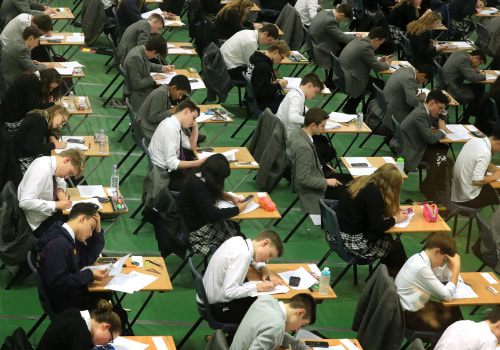
The GCSE MathematicsGCSE Mathematics document without a calculator will ask questions related to the content of any part of the program. There are a total of 80 points in play and the article contributes 33.3% of your overall GCSE Math score. A combination of question styles, from short one-brand questions to multi-step problems, will be included in the exam. The mathematical demand increases as the student progresses through the work.
The test will last 1hr30m and is the first of three parts. Students will need to memorize many of the formulas that are currently given in the formula sheets at the beginning of the exams. Each package focuses on the key skills students need to develop to perform well on the higher-level GCSE exams and includes detailed step-by-step answers and grading outlines for each question. For those who sit down to Edexcel GCSE mathematics, the exam without a calculator will be held on Thursday morning, May 24. The Edexcel GCSE mathematics exam is divided into three separate papers, each part having a value of 80 points and a weight of 33.3 percent. The test will last 1hr30m and is the first of three parts. Students will need to memorize many of the formulas that are currently given in the formula sheets at the beginning of the exams. Each package focuses on the key skills students need to develop to perform well on the higher-level GCSE exams and includes detailed step-by-step answers and grading outlines for each question. For those who sit down to Edexcel GCSE mathematics, the exam without a calculator will be held on Thursday morning, May 24. The Edexcel GCSE mathematics exam is divided into three separate papers, each part having a value of 80 points and a weight of 33.3 percent.
The topics covered in this exam could include any of those previously mentioned, such as algebra, geometry, trigonometry, statistics, and probability. In order to do well on this exam, it is important to be familiar with all of the topics that may be covered. It is also important to practice solving problems without a calculator in order to get used to working out equations without one. Additionally, it is important to review all formulas that may be used in order to ensure accuracy when solving problems. By preparing for this exam ahead of time, students can ensure that they are ready for whatever topics may come up during the test. With practice and dedication, students can feel confident when taking their GCSE Mathematics Exam without a calculator.